RSS.com encourages creators to transparently disclose AI usage in their podcasts. Labeling your episodes with the AI tag is more than a formality. It preserves listener trust, improves platform safety, and aligns with evolving industry norms and advertiser expectations.
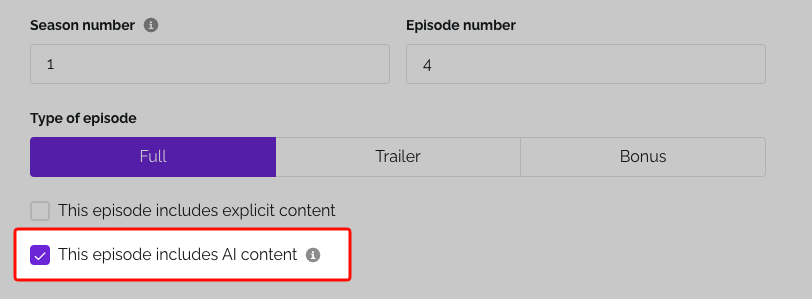
When should you use the AI tag?
The AI Disclosure should be used when the core substance of your podcast episode, whether that is the voice, the music, or the synthesis of the episode, is significantly produced by artificial intelligence.
The key question is simple: is AI doing the creative work your listeners came for? If AI is the performer (delivering the content listeners engage with), disclose. If AI is a production tool (supporting your creative work), no disclosure is needed.
Not sure whether your episode needs the AI disclosure? Use this free online tool to find out.
Examples
A few common scenarios to illustrate the line:
AI voice narrates the episode (or an AI conversation like NotebookLM): Tag required. AI is the performer.
You clone your own voice to deliver a script you wrote yourself: No tag required. The creative substance (your ideas, your words, your editorial judgment) is yours. AI is just the delivery method.
AI writes your script and you record it in your own voice: Tag required. AI created the substance your listeners came for, even though a human performed it.
AI-generated background music, sound effects, or a short intro bumper: No tag required. These are production elements, not the substance of the episode.
Noise removal, filler-word removal, audio leveling, transcripts, show notes: No tag required. Standard production tools.
For the full framework, worked examples, and a cross-platform comparison of what Apple Podcasts, YouTube, Spotify, Meta, and the EU AI Act require, read the complete guide at shouldidisclose.ai/about.html
Was this article helpful?
That’s Great!
Thank you for your feedback
Sorry! We couldn't be helpful
Thank you for your feedback
Feedback sent
We appreciate your effort and will try to fix the article